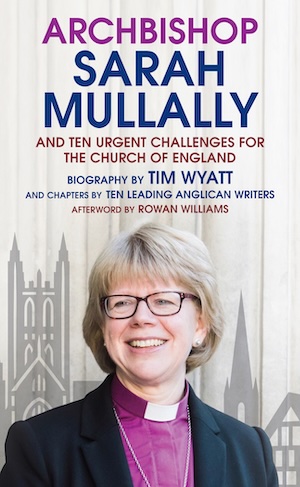
Archbishop Sarah Mullally and Ten Urgent Challenges for the Church of England was published in February, just a couple of weeks after Sarah Mullally officially became Archbishop of Canterbury. Its 200 or so small pages contain of a biography by Tim Wyatt (32 pages), ten chapters on various topics, and a very short Afterword by Mullally’s predecessor-but-one, Rowan Williams. No editor is named, so the choice of topics and contributors is presumably that of the publisher (DLT).
The biography is the first of two biographies of Archbishop Sarah Mullally that have already been published. The second, by Andrew Atherstone, was published in late March, around the time that Mullally began her ministry as Archbishop, and is the first full-length biography. Wyatt’s biography draws heavily on interviews (including with Mullally herself), and focuses on her character through her impressive career in nursing and her subsequent rise through the ranks in the Church of England. Little attention is given to her teaching or to her vision for the church. I don’t yet have Atherstone’s biography, but the impression I have is that it is likely to be complementary to Wyatt’s, focusing more on written materials and on her views, as well as being much more detailed.
The brief Afterword by Rowan Williams is also worth reading. It begins as follows: ‘The point of having any kind of ordained ministry in the Church is that there should be those whose primary task it is to help the Church be itself.’ This is true for archbishops too. It involves listening to stories from local churches and sharing those stories with other local churches. It is important to remain firmly connected to the local, in order to avoid being oppressed by the media, or taking refuge in ‘abstract goals and strategies’.
As for the rest of the book, there is little about Mullally herself, and little actual analysis of the challenges she is likely to face as Archbishop. Instead, ten contributors write about topics that are important to them, while other topics are entirely absent. For example, there is nothing about declining congregations, church growth, church planting, finances (either local or national), buildings, volunteers, children and young people, women’s ministry, vocations, worship, schools, or theological education. Even allowing for the pressures of publishing in a hurry, this is quite a list of omissions, to put it mildly. The choice of topics probably says more about the publisher than it does about the Church of England. I will spare you the details, but here are the book’s ten ‘urgent challenges for the Church of England’:
- Spirituality (Mark Oakley)
- Nationalism and Racism (Eileen Harrop)
- Inclusion of Disabled People (Emily Richardson)
- Inclusion of LGBTQIA People and Same-Sex Marriage (Charlie Bączyk-Bell)
- Inclusion of Trans and Non-Binary People (Christina Beardsley)
- Safeguarding (Andrew Graystone)
- Poverty (John Kuhrt)
- Climate Care (Ruth Valerio)
- Global Anglican Unity (Amatu Christian-Iwuagwu)
- Mission (Chantal Noppen)
Some of the chapters are quite good, some are quite predictable, and some basically call on the new Archbishop to speak up about the topic in the House of Lords and elsewhere. The chapter that made the deepest impression on me was the one on abuse and safeguarding by Andrew Graystone, ‘Falling Among Thieves: Understanding and Responding to Church-Related Abuse’, an earlier (and longer) version of which was published in 2022 by the William Temple Foundation as a Temple Tract, under the same title (with a somewhat critical Foreword by Archbishop Stephen Cottrell, which is also worth reading).
There is no doubt that Sarah Mullally will face great challenges as Archbishop of Canterbury. Wyatt portrays her as a ‘safe pair of hands’, and she could well be suited to the moment. During her time as archbishop, let’s pray that some of her personal stability will be shared with a church that so desperately needs it.