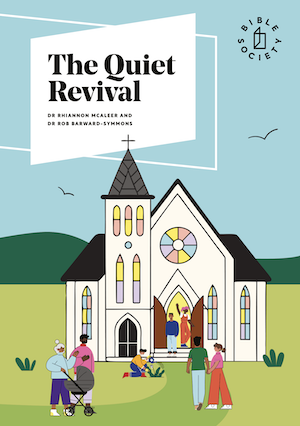
I shared some thoughts yesterday in response to recent developments about the withdrawal of The Quiet Revival, the report from Bible Society. In this post, I want to focus in more detail on the claims of the original report and on what happens next.
One of the things Bible Society are not very good at is admitting when they are wrong.
True, most of the blame for the problems with The Quiet Revival lies with YouGov. They have made a statement and issued an apology:
YouGov takes full responsibility for the outputs of the original 2024 research, and we apologise for what has happened. We would like to stress that Bible Society have at all times accurately and responsibly reported the data we supplied to them.
However, it was a sign of naivety on the part of Bible Society to place so much confidence in one dataset, and a sign of hubris to defend it so doggedly against all criticism. They were wrong on both counts, and I don’t think they have admitted this.
BBC News, reporting on the withdrawal of the report, quotes Professor David Voas, emeritus professor of social science at University College London, who was ‘one of those who raised suspicion over the Bible Society’s findings’:
‘We’ve been telling them (the Bible Society) for the better part of a year that there were serious problems with the data – and even what those problems were likely to be – and they refused to engage with us,’ says Professor Voas.
‘I don’t know whether to feel gratified by the vindication or annoyed by the amount of time I wasted in pointing out that the numbers were clearly wrong,’ he says.
Tim Wyatt has been similarly sceptical of the claims of The Quiet Revival, leading to some unpleasant exchanges, which he outlines in a recent post entitled, ‘I told you so’.
The initial report contained not a hint of humility. When a single dataset gives a surprising result, it is a sign of academic virtue for the claims to be couched in tentative language. For example: this is just one dataset, samples of this nature have various vulnerabilities and should always be confirmed by other datasets, and the headline claims should all be qualified with, ‘if these findings prove to be accurate’ or similar, with calls for further research.
Instead, The Quiet Revival was written with the language of absolute certainty: ‘proof’ (pp. 12, 48), ‘fact’ (pp. 12, 43, 48), ‘proves’ (p. 42), etc. On the reliability of the sample, they say:
Is the methodology sound?
Yes, both surveys we draw from are based on large, representative samples from one of the country’s leading research companies. Both sample sizes give a 1% margin of error at a 99% confidence level, meaning they are highly reliable (p. 46, cf. p. 11).
This means that they thought we could be 99% sure that results based on the whole dataset are accurate to within plus or minus 1%.
It is difficult to square this with their new claim that ‘We’ve always been open about the fact that a 12 per cent figure for churchgoing might be too high’. While that may be true of subsequent comments, there is not a hint of that uncertainty in the original report.
Now that the dataset underlying The Quiet Revival has been withdrawn as unreliable, does that mean Bible Society are withdrawing their claims of a ‘Quiet Revival’? Far from it. From the FAQs (emphasis added):
Were the original findings simply wrong, or is the picture more complicated?
The error means that we can’t rely on the YouGov data, but the amount of corroborating evidence that’s emerged during the last year means that we’re still confident that there is a Quiet Revival going on, with more young people open to faith, a greater warmth towards Christianity, and churches across England and Wales reporting their own experience of growth.
(Notice the subtle shift from statistical evidence to anecdotal evidence when they speak about church growth.)
Bible Society issued a statement, which includes the following:
We would wish to stress that YouGov’s error does not mean that all of the findings were wrong – it means that we cannot reliably support those findings on the basis of this survey.
They have issued a new report, as described on their website:
But this isn’t the end of the Quiet Revival story. During the last year we’ve heard amazing stories of growth from churches across England and Wales. We’ve found new data and surveys that back up our conviction that a real change is happening. Our new report, The Quiet Revival one year on: what’s the story? outlines our reasons for believing this. We hope you’ll be encouraged.
(Notice again the shift from statistical evidence to anecdotal evidence when they speak about church growth.)
However, that new report makes no claims about church growth. It includes Bible Society analysis of Pew Research Center data from 2024, which broadly agrees with the original findings of The Quiet Revival, and also similar research from the British Social Attitudes Survey in 2024, which presents a very different picture. Far greater prominence is given to the Pew data, while the British Social Attitudes findings are confined to a single figure near the end of the report. There is no baseline in a previous year, which is why I say that this new report makes no claims about growth. Indeed, had they included data from previous years from the British Social Attitudes Survey, this would have presented clear evidence of decline.
I have to say that this blatant favouring of datasets that give the results you want to believe to be true is a clear sign of a lack of humility and honesty on the part of the researchers. They seem more eager to advance a narrative than to seek the truth.
What next? From the new report:
It seems to us that, with the appropriate learning applied to changed procedures, such errors can be avoided in the future. For this reason we intend to work with YouGov on a further 2026 wave of our research programme – another large-scale survey of attitudes toward the Bible and faith that will enable us to refresh and update The Quiet Revival report later this year. However, we will also commission other providers using alternative methodologies so we are able to offer a rounded picture of Christianity and the Bible in England and Wales (p. 4).
This is a very welcome development. What might this research find? The new report poses a question:
Are the findings of The Quiet Revival report true or false? (p. 4)
But then there is a bit of bait-and-switch about the claims of the original report.
On [this] question, our conclusion is that the core themes and messages arising from The Quiet Revival report are substantially true (p. 4).
What are these ‘core themes and messages’? As follows (emphasis added):
- There is a significant change in the spiritual climate in England and Wales
- The default position on questions of religious identity is shifting from ‘Christian’ to ‘no religion’
- Cultural shifts are leading many, but especially the younger generation, to be more proactive in seeking spiritual and religious foundations for questions of identity, meaning and purpose
- Christianity in Britain is experiencing both a decline in nominal faith, and a growth in active faith Increased Bible sales, baptisms, reports of increased church attendance and a surge in individual testimonies all point toward substantial new conversion to Christian faith in recent years (p. 4)
Notice how ‘reports of increased church attendance’ is merely one small part of what they now identify as the ‘core themes and messages’ of The Quiet Revival.
Let’s be clear: the single central claim of The Quiet Revival was that the church is growing. This, surely, is what is meant by ‘revival’. What else is a ‘revival’ if not a period of rapid and significant church growth? It simply will not do for Bible Society to find later in the year that, actually, church attendance has been declining after all, but that there is still a ‘Quiet Revival’ going on, because of all the other things listed above. If there is no increase in overall attendance, then whatever is happening, it is not a ‘revival’. You could describe it as a ‘spiritual awakening’, or a ‘surprising rebirth of belief in God’ (to use Justin Brierley’s phrase), or many other things, but if the overall statistics for church attendance do not indicate significant growth, then we are simply not experiencing what church historians would describe as a ‘revival’. Those other things might give us reason to believe that a genuine revival is on its way, but they do not themselves count as a ‘revival’ in the most obvious meaning of the word.
Let me substantiate my assertion that the single central claim of The Quiet Revival is that the church is growing.
From the back cover, in bold print (emphasis added):
For many decades now, the general assumption has been that Christianity in England and Wales, and in particular churchgoing, is in irreversible decline.
Further down that back cover (emphasis added):
There has, however, been a growing body of evidence over the last few years telling a different story. … Firm numbers, though, have been hard to come by – until now.
Using nationally representative data from a prestigious polling agency, The Quiet Revival demonstrates that far from declining, the Church has been growing since at least 2018. … The Church is transforming before our eyes, and the figures presented in this report show the proof.
Paul Williams, CEO of Bible Society, writes in the Foreword (emphasis added):
For decades, Church attendance and nominal adherence to Christianity has been declining, and it has been assumed that this decline would continue and was in some sense an inevitable product of modernity. While the decline has certainly been real, we now know that the trend has been reversed. The tide of faith, whose ‘melancholy, long-withdrawing roar’ was described by Matthew Arnold, has now turned.
The results of this thorough and robust study demonstrate that over the space of only six years, there has been a significant growth in the numbers of people going to church … (p. 4).
The next page contains the ‘Report in 30 seconds’, including this (emphasis added):
Where once we saw aging congregations and a steady decline in attendance, we see dramatic growth, led by the young. Where once we saw apathy or even hostility to Christianity and the Bible we see increased openness, again among the young. You may have heard the rumblings and rumours emerging over the past few years, you may even have noticed it in your own community, or it might have passed you by entirely – but this data shows that it is real. This is the Quiet Revival. For the first time, this is not just anecdote, but is demonstrated in the latest results of a large, robust and nationally representative population study that has tracked the religious attitudes and behaviours of England and Wales since 2018.
We found that the Church is in a period of rapid growth, driven by young adults and in particular young men. … But we also see that active engagement with a church has a significant impact on the lives of attenders … . Challenges remain for the Church and civic society in responding to this Quiet Revival, but its reality can no longer be denied (p. 5).
The report then has 10 ‘Key findings’, the first of which is ‘The growing Church’ (emphasis added):
Church attendance in England and Wales is on the rise. This represents a startling change to decades-long trends and presumptions, with the most dramatic increase seen among young people, particularly young men. In 2018, just 4% of 18–24-year-olds said they attended church at least monthly. Today this has risen to 16%, with young men increasing from 4% to 21%, and young women from 3% to 12%. … Overall, churchgoing Christians now make up 12% of the population, up from 8% in 2018. In numerical terms, that’s growth from 3.7m in 2018 to 5.8m in 2024 – an increase of 56% (p. 6).
After some introductory material, the report begins in earnest by setting the scene (emphasis added):
For many decades now, the general assumption has been that Christianity, and in particular churchgoing, in England and Wales is in a state of permanent decline. …
Yet over the past few years, a different story has been emerging from the peripheries. … But firm numbers have been hard to come by – until now.
Using nationally representative data through a prestigious polling agency, The Quiet Revival demonstrates that far from declining, the Church has grown.
The first chapter, ‘What’s happening?’, begins with this paragraph (emphasis added):
Our results present a radical challenge to long-established predictions around the future of religion – and in particular Christianity – in twenty-first century Britain. Instead of a continuing decline we see explosive growth; instead of a Church populated predominantly by older women, we see a rising number of men and younger generations joining. As a result, the Church is not just growing but transforming, with young adults leading the way (p. 15).
The Quiet Revival is about ‘The growing Church’ (key finding 1) and also ‘The changing Church’ (key finding 2), but it is the growth of the church that is foregrounded, and it is the growing church (rather than the changing church) that warrants the label of ‘revival’.
Are the findings of The Quiet Revival report true or false? This is a simple question. It could be phrased like this: Is the Church in England and Wales in a period of rapid growth or not? If the new YouGov polling finds evidence of significant church growth, then the central finding of The Quiet Revival might well be true, but if the new polling finds evidence of decline, or no evidence of ‘rapid’ or ‘explosive’ growth, then the central finding of The Quiet Revival might well be false. It’s as simple as that.
I hope and pray that the church is growing. I am sure that growth is taking place in some respects, and that decline is not the whole story. Clearly there is decline, in that a churchgoing generation is passing away. But, simultaneously, there is clearly something of a spiritual awakening among the largely unchurched younger generations. Those two trends are both happening. If the growth is significantly greater than the decline, then you could describe the current situation as a ‘revival’. But If not, then it would be wrong to describe this period of church history as a ‘revival’, although there might well be signs that revival is on the way. Whatever the outcome, I hope Bible Society will have the humility to be honest about the new findings.