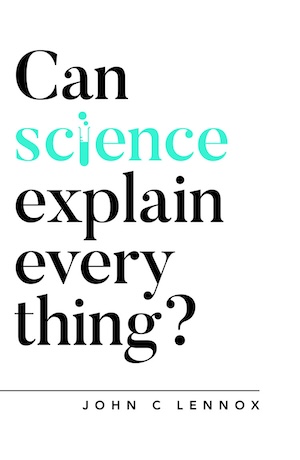
This short and readable book by John Lennox, from 2019, has a title that I find a bit puzzling: Can Science Explain Everything? I find it puzzling because I don’t think it is the main theme of the book.
Alternative titles might have been: God and Science: Following the Evidence or Science and Christianity: Foes or Allies? or Is Christianity Falsifiable? or Can Science Disprove God? or (from the title of the concluding Chapter 10) Testing the Truth of Christianity.
The theme in the title appears briefly at either end of the book, and is addressed in Chapter 2. Contrary to the claim ‘that science is the only way to truth … a belief called “scientism”’ (p. 26), science has its limits, in that it cannot answer questions of purpose. Furthermore, although ‘the laws of nature describe the universe … they actually explain nothing’ (p. 35). (To be fair, this is more a matter of different levels of explanation: the laws of nature might provide a proximate explanation for why things behave as they do, but the laws of nature cannot provide an ultimate explanation for the laws of nature themselves.)
If the book’s title is only a minor theme in the book, we get a little closer with the question of whether science and Christianity mix. But I don’t think this is the main theme of the book either. The ‘Introduction: Cosmic chemistry’ poses the question of what happens when you combine God and science. Do they mix? Many think it would be an explosive combination. But Lennox wants to suggest ‘that a different kind of cosmic chemistry is possible’ (p. 12). Chapter 1 points out that lots of eminent scientists (past and present) have been Christians. So there is clearly no essential conflict between being a scientist and having faith in God.
The book’s primary theme is not simply the claim that science and Christianity are not incompatible. Lennox invites the reader to be ‘prepared to follow the evidence where it leads’ (p. 12), and, as the book proceeds, it becomes clear that his claim is that a scientific approach to the evidence leads towards Christianity. This is the theme of Chapters 3 to 10.
The Preface contrasts this book with Lennox’s earlier book, God’s Undertaker: Has Science Buried God? (from 2007, updated in 2009), which I read in 2010. That book contains a lot of similar material about the nature of science and the role of faith and evidence, but its focus is primarily on evolution and the question of whether the existence of complex information points towards the existence of an Intelligence (i.e., God). This newer book is much shorter, and its focus is on the evidence for the resurrection of Jesus. As such, there isn’t actually a lot of science at the heart of the book – at least not in the ‘physics, chemistry and biology’ sense. The core of the book is really about history – not one of the ‘natural sciences’, but just as ‘scientific’ in its rigorous examination of the evidence. It is possible to investigate ‘unique past events’ in a scientific way, not using a process of ‘induction’ (‘repeated experimentation’), but using a ‘forensic’ process of ‘abduction, or, inference to the best explanation’ (pp. 90-91).
Chapter 3 begins the process of mixing science and Christianity by arguing that science, like religion, depends on faith. Atheism is a belief system, and depends on faith. Science also depends on faith: faith that the universe is intelligible. Which belief system is better as a foundation for science? Atheism provides no basis for trusting our own rationality. Why should we trust our brains, if they are the result of mindless evolution? ‘How could I be impressed with a worldview that undermines the very rationality we need to do science? Science and God mix very well. It is science and atheism that do not mix’ (p. 49). ‘The Bible gives us a reason for trusting reason. Atheism does not’ (p. 51).
Chapter 4 balances Chapter 3 by arguing that Christianity, like science, depends on reason. The Bible supports reason, and there is a biblical mandate for doing science. ‘[W]e should be prepared to follow the evidence where it leads, even if that involves a supernatural dimension’ (p. 60). ‘Christianity is an evidence-based faith’ (p. 62). Indeed, Jesus used signs and rational argument to provide evidence as a basis for faith.
Chapters 5 to 8 form the core of the book, looking at the evidence for the resurrection of Jesus. This evidence comes from the Bible, so Chapter 5 is about how we interpret the Bible. We need to keep in mind that ‘The Bible, like all literature and speech, is full of metaphors and highly pictorial language’ (p. 69).
Chapter 6 is about miracles. God established the laws of nature, but this doesn’t mean he cannot intervene to bring about a miracle. This is because ‘Christians do not believe that this universe is a closed system of cause and effect’ (p. 81). ‘Whether any specific miracle, like the resurrection, has actually occurred, is now a historical question, and not a philosophical one, and depends on witness and evidence’ (p. 82).
Chapter 7 looks briefly at high credentials of the New Testament, both in terms of the quality of the manuscript evidence, and in terms of historical reliability.
Chapter 8, ‘How to disprove Christianity’, provides the turning point of the book, and argues that the resurrection of Jesus is the best explanation for the evidence. ‘The existence of the Christian church throughout the world is an indisputable fact. What explanation is adequate to explain the transformation of the early disciples? … If we were to ask the early Church, they would answer at once that it was the resurrection of Jesus’ (pp. 100-101).
Chapter 9 begins to explore the ‘personal dimension’. If the resurrection is true, what does that mean for me? Lennox explains why Jesus died on the cross, and how salvation in Christianity is a gift of grace, not based on merit.
Chapter 10 concludes by urging the reader to test Christianity experientially, by recognising the way that Christian faith has transformed countless lives, and by taking a step of trust in Christ.
The book is really quite evangelistic in it purpose, but in the gentle way you might expect if you’ve ever heard John Lennox speak. It would be ideally suitable for people who are committed to science but who struggle with Christianity.