Ceci n'est pas un blog
Physics and astronomy: worth billions?
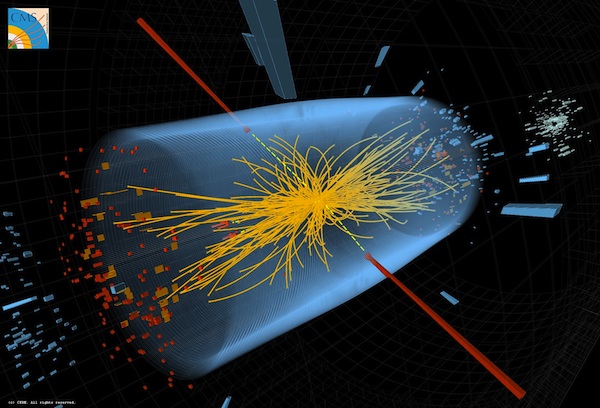
As folk at CERN prepare not to announce the discovery of the Higgs boson (apparently), other folk have been discussing whether it's worth the money.
On the Today Programme, Lucie Green and Adam Rutherford discuss the cost of figuring out how the universe works, making the assumption (understandably) that for some reason we actually want to understand how the universe works.
Meanwhile, on the Guardian website, Jon Butterworth seems to argue that this kind of research is valuable because the technology of the future will be built on the fundamental physics of today, and because if we are good at solving this kind of question (such as whether the Higgs boson exists), we will probably be not too bad at solving other (more useful) questions.
But if you leave the economic, technological and societal spin-offs to one side (and factor that into the cost), is there any value in simply knowing stuff about the universe, such as what we are made of, how big the universe is, and how we got here?
Surely the answer to that must be "yes". Tell anyone that you are doing research in astronomy, and they find it fascinating. (In my experience, they then go on to tell you about some recent discovery that you knew nothing about, which is always slightly embarrassing!) Research into fundamental questions about the universe really does make a positive difference to people's lives.
But how does this happen? How exactly will my specific piece of research enrich people's lives? And how do we figure out how much new research we need? Do we even need any new research, or do we know more than enough already?
Answers appreciated!
| Print article | This entry was posted by Anthony on 13 Dec 2011 at 1.05 pm, and is filed under Astronomy & Science. Follow any responses to this post through RSS 2.0. You can leave a response or trackback from your own site. |

I live in York and I
about 1 year ago
"How do we figure out how much new research we need?"
I think that really is the tricky question. Because it's obviously worthwhile to know more about the universe even if the knowledge has no application. But it's also worthwhile to be able to do a whole host of other things we might do with the resources, too: and we can't do all of them!
Direct comparisons are quite invidious, but even in the state-funded sector we could think about education, healthcare and other things which we also think are important. And then, of course, the government has to raise the taxes in the first place, which causes less activity in market sectors of the economy: retail, manufacturing, agriculture and so on. How much of that are we willing to give up for the other stuff? (Especially given that we often can't really choose what precisely it is that we would give up to get the knowledge.)
That's not an answer, but I hope it sharpens the question.
about 1 year ago
It does indeed.
As you know, I sometimes toy with the idea that the state should not compel people to fund this kind of research if they don't think it's worthwhile. In other words, research could be funded by voluntary contributions, a mixture of rich benefactors, and not-so-rich people voluntarily giving (say) 1% of their income towards research. This could go towards specific areas of research, or be given to RCUK to be distributed as they see fit (and the Haldane principle could become a reality!). That way, if people think astronomy (say) really enriches their lives, and they'd like more of it, then they can express that with their wallets. And my question will answer itself. (See - I'm not completely anti-market!)
But all of that is completely fanciful in the actual world, I suspect.
Still no answer. But academics are meant to ask questions, not find answers, right?