about 11 months ago - 7 comments
I've been pondering the issue of creation and evolution for years, and I thought it was about time to set out my current thinking on the area. This is all provisional and subject to change, but the points below are things that I'm fairly sure about. If you desperately want to label me with one…
about 11 months ago - 2 comments
It's not clear precisely what role scientific evidence plays when someone chooses between young-age creationism and evolution over billions of years. Certainly no one can approach the issue dispassionately; we would all have to declare an interest if we were called upon to examine the evidence objectively. But still, we can try to think about…
about 1 year ago - 4 comments
I posted this elsewhere a few months ago, but I thought it was worth posting it here too. The Christian church is still a long way from resolving the creation/evolution issue, but maybe this points in the right direction. The Colossian Forum is some new thing trying to promote discussion on issues of science, culture…
about 2 years ago - 5 comments
This post concludes my recent splurge on Intelligent Design (ID). I have been trying to argue: That ID is basically anti-evolutionism That, as anti-evolutionism, ID is half an argument for creationism That the question of whether ID is science is actually quite dull That ID proponents are right to point out the speculative nature of…
about 2 years ago - 12 comments
I don't see why not. Many people in the UK believe in Intelligent Design (that is, they don't believe in modern evolutionary theory), 51% according to one report. This in itself is a good reason to expect children at least to be familiar with the term and what it means. They should learn about some…
about 2 years ago - 19 comments
The basic argument of anti-evolutionism (Intelligent Design, ID) is that chance processes cannot account for the complexity that we see in living things. The probabilities are simply vanishingly small. That may be true, but I'm nervous about that kind of argument. The reason is that I'm not sure we properly understand complexity. There are examples…
about 2 years ago - No comments
I find myself in full agreement with the basic presupposition of Intelligent Design (ID): that a world in which an intelligent agent has acted might be expected to be different to a world in which no such intelligent agent has acted, and that the methods of science (i.e., empirical enquiry) might be a useful tool…
about 2 years ago - 7 comments
One of the quotes Michael Behe showed at Monday's Darwin or Design? evening was the following: "We should reject, as a matter of principle, the substitution of intelligent design for the dialogue of chance and necessity, but we must concede that there are presently no detailed Darwinian accounts of the evolution of any biochemical system,…
about 2 years ago - No comments
Countless hours have been wasted poring over this most uninteresting, pedantic and pointless of questions. Rather than seeking to answer the questions raised by Intelligent Design (ID), certain people seem to think it is much more pressing to determine once and for all in which drawer of the filing cabinet the question should reside. Enough!…
about 2 years ago - 18 comments
No. But there is a connection. Intelligent Design (ID), being essentially anti-evolutionism, is half of an argument for creationism. Basic scientific arguments go something like this: You are wrong. I am right. Or, in more detail: Your model does a poor job at explaining the data. My model does a better job at explaining the…
about 1 year ago
Many people believe that creationism or intelligent design are scientific theories.
They are wrong. They are religious dogma trying to foster the pretence that they are science.
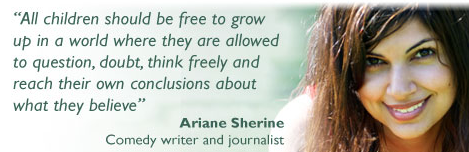
Will you encourage children to reach their own conclusions on the matter?
Only if they are presented with accurate information. Mind you, for children to reach their own conclusions they need a thorough grounding in the evidence on which evolutionary theory is based, something which is usually achieved at University. It's not the job of schools to teach at this level. We have recently learned that some subatomic particles may travel faster than the speed of light - which would be a serious challenge to relativity theory. Do you think children should be allowed to reach their own conclusions on the validity of Einstein's theories?
Creationist sources - which includes ID, of course- rely on misrepresentation, distortion and outright falsehoods to promote their claims for scientific legitimacy. I do not want children to be exposed to outright falsehoods masquerading as science.
If you don't think I'm accurate in my characterisation of creationism, here is my analysis of several creationist web sites showing their deep and fundamental dishonesty:
http://plesiosaur.com/creationism
You can show that I'm wrong by producing evidence that I'm wrong. If you can't, why should we not conclude that creationism is fundamentally dishonest, and that this in itself is sufficient reason for not teaching it in our schools?
about 1 year ago
Hi Richard,
Note that the discussion is not about whether creationism or ID are true, but only about whether they are scientific theories.
Are you saying that teachers should dogmatically assert the (philosophical, not scientific) claim that "creationism and 'intelligent design' are not scientific theories", without needing to provide any evidence to substantiate that claim?
I would have no problem with students learning (for example) that the vast majority of philosophers of science do not regard creationism or ID as scientific theories - assuming that is true, of course! - or the (less relevant) fact that most scientists do not regard creationism or ID as scientific theories.
But I do have a problem with children being forbidden "to question, doubt, think freely, and reach their own conclusions about what they believe", which is what the statement is calling for in respect of this particular philosophical question.
about 1 year ago
Are you saying that teachers should dogmatically assert the (philosophical, not scientific) claim that "creationism and 'intelligent design' are not scientific theories", without needing to provide any evidence to substantiate that claim?
I'm saying that creationism does not offer any scientific theory because
1) It is not built from empirical evidence
2) It does not present any model which explains how biological systems originate
3) It offers no evidence to support any theory, only supposed falsifications of evolutionary theory
4) It explicitly attacks naturalism, which is the fundamental assumption which makes science possible (and if you think otherwise, please tell us how one can engage in a scientific investigation other than under the assumption of naturalism)
5) It promotes it cause by dishonestly misrepresenting the views of scientists, by dishonestly presenting this as a conflict between science and religion, and promoting outright falsehoods about science and religion.
This is not a philosophical dispute over the nature of science, and even if it were, the school classroom is not the appropriate forum in which to engage in such a debate. It is a simple issue of honesty: creationists promote their cause by misrepresentation, distortion and outright falsehoods, as I have demonstrated with my analysis of several creationist sites. If you think I'm wrong, address the evidence I present. Or produce a link to any creationist site which you consider to be honest.
I've challenged creationists many times to do so, but none has even attempted to demonstrate that I am wrong. From this, I conclude that creationists know that their cause is being argued dishonestly, but find such dishonesty acceptable provided it comes from one of their own.
I don't, and I don't want children to be exposed to the misinformation and outright falsehoods of creationists. Coming as it does from those claiming the moral high ground, it is utter hypocrisy.
about 1 year ago
Note that the discussion is not about whether creationism or ID are true, but only about whether they are scientific theories.
Oh, and no, creationism is not a scientific theory. Scientific theories set constraints on possible outcomes. That's what makes them testable. All scientific theories are held to be provisional and subject to revision or rejection if that is what the evidence demands - and note that currently both of Einstein's theories of relativity, both of which are extremely robustly supported by evidence, are being challenged by data which they cannot explain.
Creationism explains everything by "God did it" - though ID creationism dissemble. Their "theory" is that "GodIMeanAnIntelligentDesigner did it". It offers nothing in the way of mechanism, no constraints on possible outcomes and therefore no way in which their "theory" can be tested - unless you can propose a potential observation or measurement which can't be "explained" by the intervention of a possibly supernatural entity, possibly using supernatural methods. The fact that ID proponents are specifically demanding that we redefine the nature of science to accommodate the supernatural shows that their agenda has nothing to do with science. It's political, religious, and in some cases I suspect simply pecuniary. Creationism is big business, which, because of US laws, can be fiddled so as to be free of taxation.
about 1 year ago
Hi Richard,
You provide five (or more) philosophical reasons for rejecting creationism and ID as scientific theories. So I think you agree with me: teachers should give philosophical reasons why creationism and ID should not be regarded as scientific theories, and should not simply dogmatically assert that view.
about 1 year ago
So I think you agree with me: teachers should give philosophical reasons why creationism and ID should not be regarded as scientific theories, and should not simply dogmatically assert that view.
No, I think that they should give creationism no more time than they give to crystal healing or to astrology. This is not an issue of philosophy. It's an issue of religious dogma masquerading as science, and promoting itself by utterly dishonest means.
School science classes are not the place to discuss philosophy of science. They are the place to teach children mainstream science, which gives them the opportunity to go on to a University education if they are interested in science. They can go into the details of the philosophy of science if they are interested in an institute of higher learning, not at school. You wouldn't expect a history teacher to talk about the philosophy of historical investigation, or a mathematics teacher to go into the philosophical underpinnings of their discipline. I would no more expect children to reach their own conclusions (as you demand) on the nature of historical enquiry than I would on the basic underlying philosophy of science, especially as the "alternative" view presented is a concatenation of falsehoods.
Oh, and I didn't give any philosophical reasons for rejecting ID. I gave entirely pragmatic reasons, not the least of which is that it's a bunch of falsehoods. Philosophy is something that follows science, worked out by philosophers after the event. Scientists define the nature of science by what they do, and how they go about it. The value of science is demonstrated by the fact that it works very well indeed, not by any philosophical revelation. As a scientist, I may occasionally find that philosophy gives some insight into the nature of what I'm doing, but it is largely something which doesn't concern me and has no impact on what I do or how I do it.
about 1 year ago
Hi Richard,
You and I clearly have different views of what philosophy is and what its value is. I see philosophy of science as essential, unavoidable, and even if it is not spoken about explicitly, it is implicit in all that is done in science, even if the scientists themselves may be blissfully unaware of it.
"The value of science is demonstrated by the fact that it works very well indeed"
That's a theory in philosophy of science called "instrumentalism".
http://en.wikipedia.org/wiki/Instrumentalism
And I still don't think you've grasped the difference between the statements "ID is not science" and "ID is not true".
And, for what it's worth, I think astrology and homeopathy should be discussed in school, quite possibly in science lessons, so children can learn that they have no empirical support.
about 1 year ago
So you go from
"Note that the discussion is not about whether creationism or ID are true, but only about whether they are scientific theories."
To
"And I still don't think you've grasped the difference between the statements "ID is not science" and "ID is not true"."
So what the hell are we discussing?
I understand the difference perfectly well.
This is not a discussion about philosophies of science. It's is about the validity of ID as science. I have no particular interest in philosophies of science because, as I explained, they are at best post hoc rationalisations of what scientists actually do, not the drivers of the process. Labelling the pragmatic view that we use science because it works as "instrumentalism" is just such a post hoc rationalisation. Attaching that label to it makes no difference whatsoever for the reasons why we accept the findings of science as useful.
about 1 year ago
"So what the hell are we discussing?"
We're discussing philosophy of science!
"It's is about the validity of ID as science"
That's a philosophical question.
"they are at best post hoc rationalisations of what scientists actually do, not the drivers of the process"
That's a philosophical statement.
But if we can't even agree about what it is we are discussing, maybe we should call it a day?
about 4 months ago
Very unusual for Richard not to have the last say. Well done. You are, of course, right, however, I feel that your words have fallen on deaf ears as Richard is a devout anti-creationists whose hatred of them exceeds any rational argument